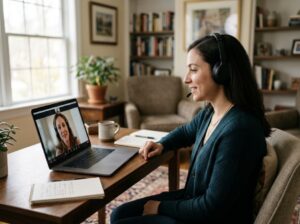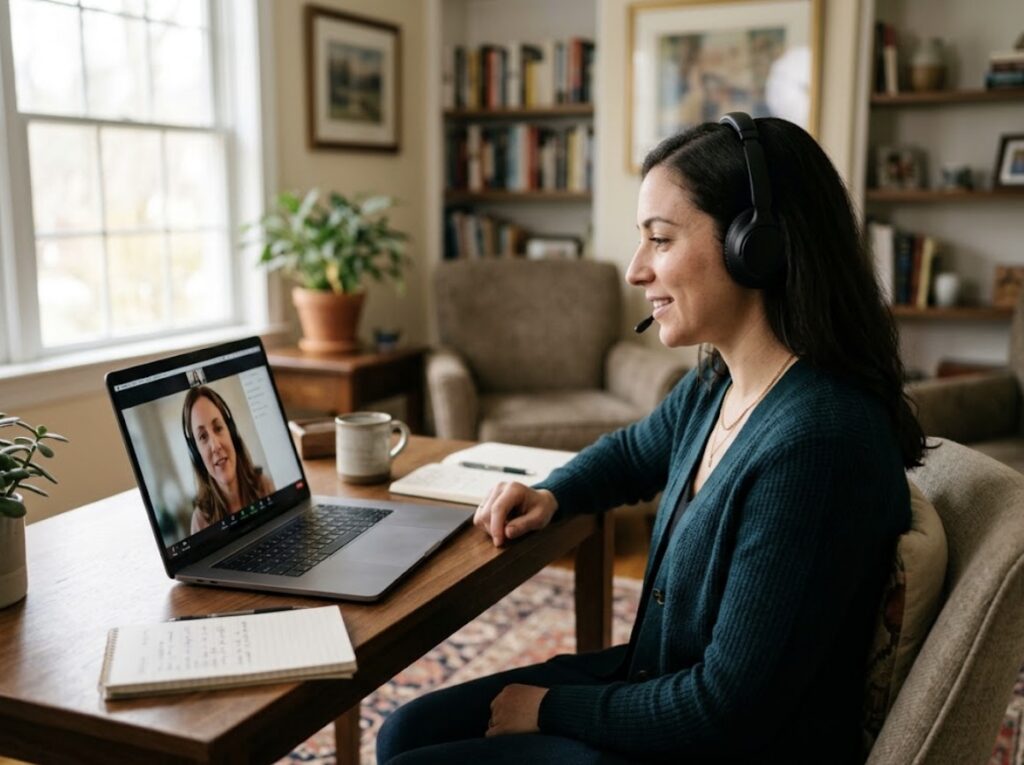
Making time for therapy can be hard when work, school, family responsibilities, caregiving, or a full schedule already take up most of the week. Even when you know you want support, traveling to an office for every appointment may make it harder to get started or stay consistent.
Telehealth counseling offers another way to meet with a therapist from a private location that works for you. Online therapy can make mental health care easier to fit into daily life without removing the personal connection that matters in therapy.
At Equality Mental Health, we work with adults, couples, children, adolescents, families, and multi-partner relationships. Our care is affirming, respectful, and centered on helping you feel understood while working through concerns related to mood, anxiety, identity, relationships, grief, trauma, family stress, and major life changes.
What You’ll Learn From This Article
- How telehealth counseling works and what makes it different from mental health apps or general online advice
- The practical benefits of meeting with a therapist online
- How online therapy compares with in-person counseling
- What concerns may be appropriate to discuss through teletherapy
- What to expect before, during, and after a virtual session
- When telehealth may not be the right fit
- How to choose an affirming therapist in Bergen County
What Is Telehealth Counseling?
Telehealth counseling is psychotherapy provided remotely, most often through secure video appointments. You may also hear it called online therapy, virtual counseling, or teletherapy.
It is still therapy. The main difference is where the session takes place.
You meet with a licensed therapist who can learn about your concerns, discuss treatment goals, help you understand patterns in your thoughts or relationships, and support you as you work through emotional and psychological challenges.
Telehealth is different from using a self-guided mental health app, joining an online support group, or reading advice on social media. Those resources may be helpful in some situations, but they do not replace individualized care with a therapist who knows your history and understands your goals.
Research has found that telemental health can extend access to mental health services and may provide care comparable to conventional treatment in appropriate settings. A systematic review published in the Journal of Telemedicine and Telecare also identified reduced travel and improved access as common advantages of remote mental health care.
At Equality Mental Health, therapy is collaborative. Sessions may focus on understanding recurring emotional patterns, improving communication, processing painful experiences, examining relationship dynamics, setting boundaries, or making choices that feel more consistent with your values.
For many people, the question is not whether telehealth is “real therapy.” The more useful question is whether meeting remotely gives you a setting where you can participate openly and consistently.
6 Benefits of Telehealth Counseling
People choose telehealth for different reasons. Some value the convenience. Others find it easier to speak from a familiar space. For many, the main benefit is having another way to access the therapist and the type of care they want.
1. Less Travel and Easier Scheduling
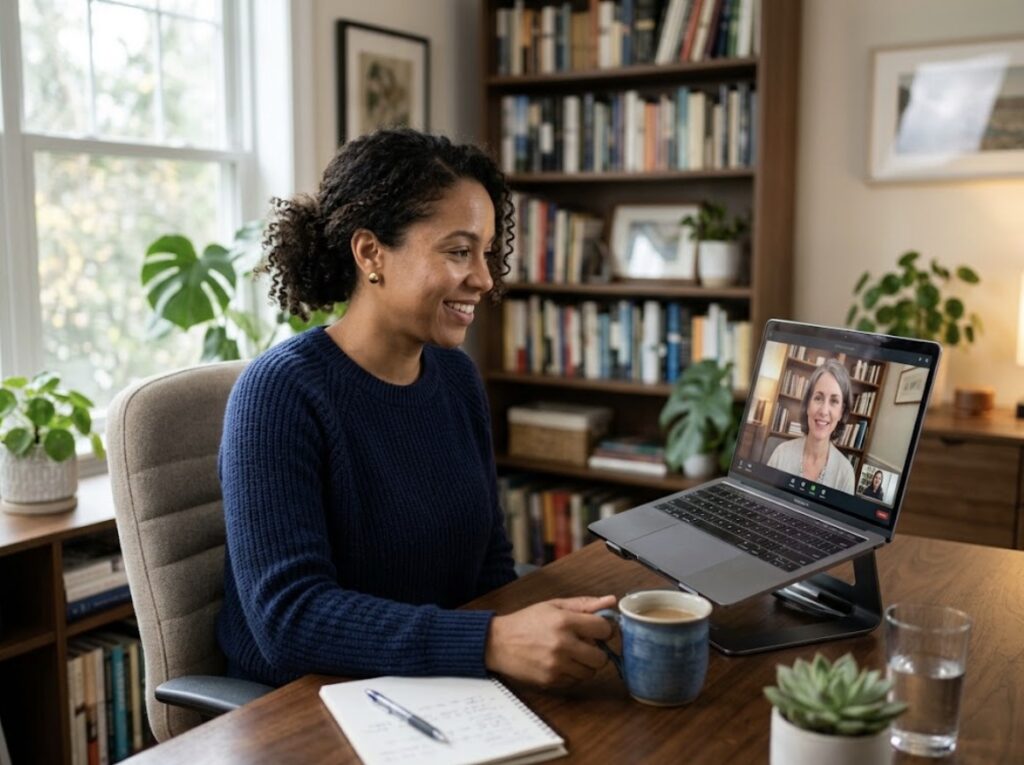
A one-hour therapy appointment can take much longer once you add driving, parking, and travel time.
Telehealth removes the commute. That may make regular counseling easier to manage if you work long hours, attend school, care for children, support family members, or have a schedule that changes from week to week.
The time saved may also make it easier to keep appointments consistent, which can matter when therapy is part of your regular mental health care.
2. More Choice When Looking for the Right Therapist

A therapist’s location is only one part of finding a good fit.
You may want someone who understands LGBTQ2+ experiences, gender identity, trauma, neurodiversity, relationship structures, body image concerns, grief, or family dynamics.
Telehealth may give you access to therapists beyond your immediate area, as long as the therapist is licensed and permitted to work with you where you are physically located.
That can matter when you have had past experiences of feeling misunderstood or judged in therapy. Feeling respected doesn’t guarantee therapy will always feel easy, but it can create a stronger foundation for honest conversations.
3. Sessions From a Familiar Space
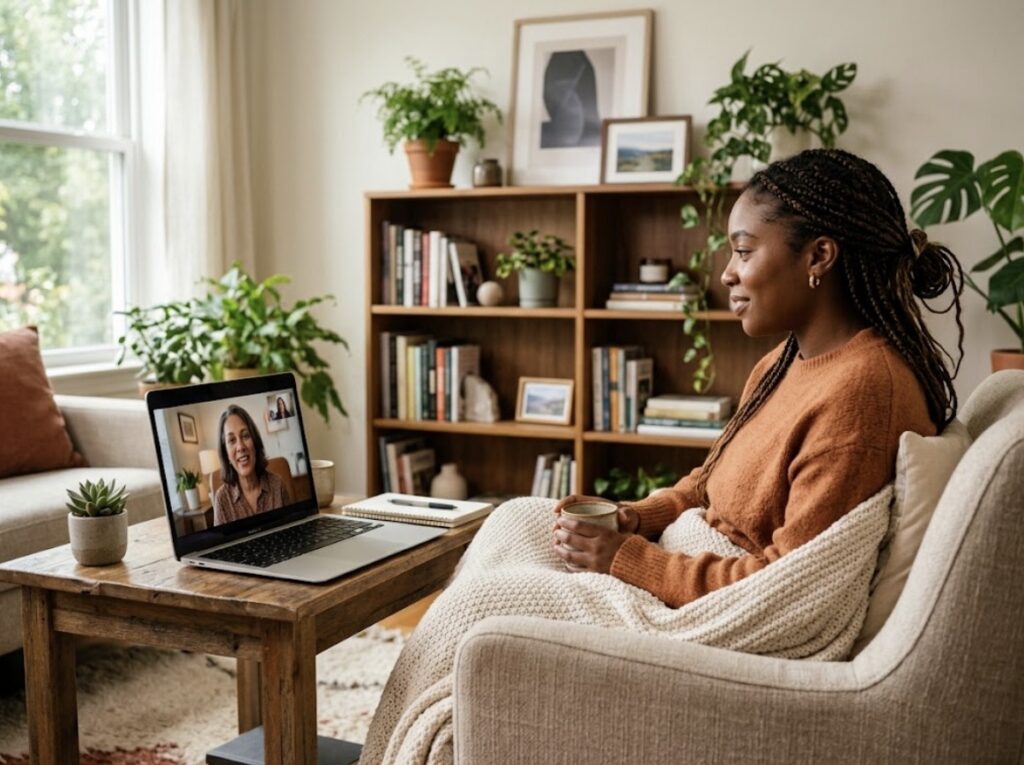
Some people feel more comfortable talking from home or another private place they know well.
A familiar setting may help you settle into the conversation more easily, especially if going to an office feels unfamiliar or stressful.
That said, home is not automatically the best environment for therapy. If you live with other people, lack privacy, or expect frequent interruptions, an office setting may feel safer and more focused.
4. More Flexibility During Busy Periods
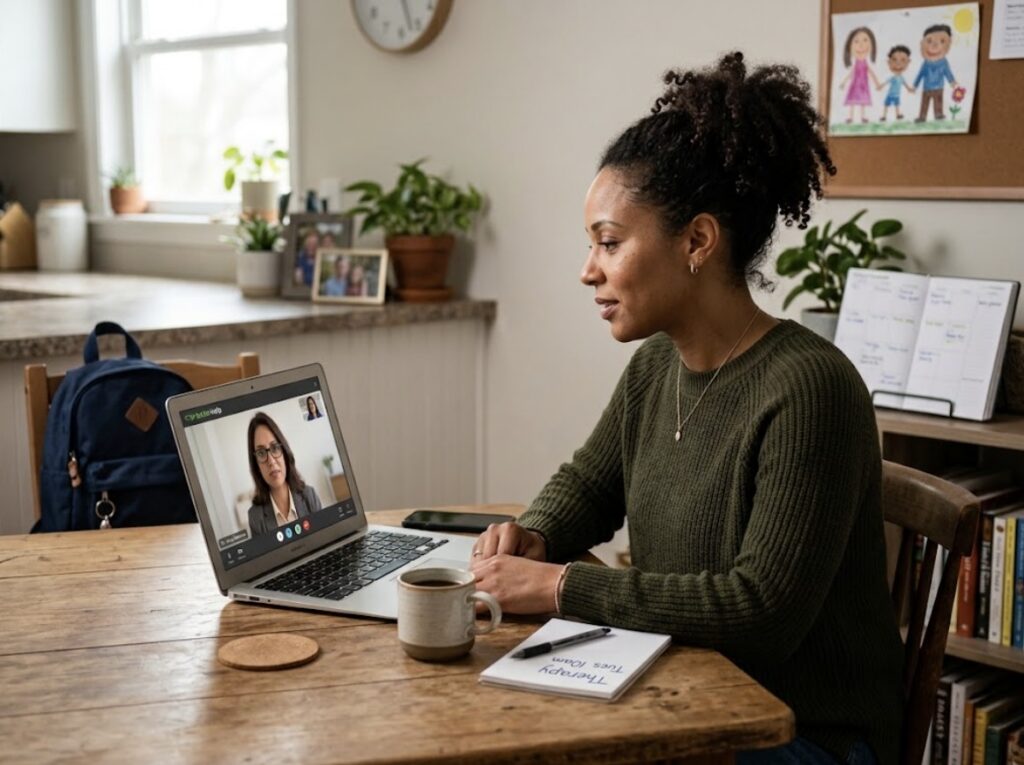
Work deadlines, parenting, caregiving, school, and personal responsibilities can all make therapy harder to schedule.
Teletherapy can reduce some practical pressure because you don’t have to plan around travel.
There are still limits. Your physical location matters during telehealth sessions because therapists must follow licensing requirements. If you travel outside New Jersey, your therapist may not be permitted to provide care while you are away.
5. A More Comfortable First Step for Some People
Starting therapy can bring up a lot of questions.
Will I know what to say? Will the therapist understand me? Will I feel judged? Is what I am dealing with serious enough to bring to therapy?
For some people, meeting through video feels more approachable than entering an unfamiliar office. Others prefer sitting in the same room with their therapist.
Neither preference is better. The right setting is the one that helps you feel present, private, and able to engage honestly.
6. Access to Professional Mental Health Care Without the Commute
Telehealth is not simply a more convenient version of self-help. It can still involve structured, therapist-led mental health treatment.
One study compared 1,192 adults receiving intensive psychological treatment through telehealth with 1,192 matched adults receiving in-person treatment. Researchers found similar reductions in depressive symptoms in both groups. The study focused on a specific treatment setting, so those findings may not apply to every client or every type of therapy.
Convenience can help, but it should not be the only factor in deciding whether online therapy fits your needs.
Can Online Therapy Be as Effective as In-Person Therapy?
Online therapy can be effective for many people, but the answer depends on the person, the concern being treated, the type of therapy, and the level of support needed.
Research generally supports telehealth as a useful way to deliver mental health services for certain populations and conditions. It does not mean online therapy works equally well for everyone.
A 2024 systematic review and meta-analysis examined remote mental health interventions for children, adolescents, and young adults. Researchers found promising results for anxiety, depression, and social functioning. They did not find the same level of benefit across every outcome studied, and the authors called for more high-quality research.
That distinction matters.
Telehealth is a way to deliver care. It doesn’t guarantee how therapy will work for a particular person.
Your therapist may consider your symptoms, treatment goals, privacy, safety needs, age, living situation, technology access, and comfort with video appointments before deciding whether remote sessions are appropriate.
For some people, telehealth becomes their preferred way to attend therapy. Others may benefit more from in-person counseling or a mix of both when clinically appropriate.
The next question is often what kinds of concerns can actually be discussed through teletherapy.
What Can Telehealth Counseling Help With?
Telehealth does not describe one specific treatment. It describes how counseling is delivered.
Depending on your needs and your therapist’s assessment, telehealth counseling may be used to address many of the same concerns discussed during office-based therapy.
Mood and Emotional Concerns
People may seek counseling for concerns such as:
- Anxiety or persistent worry
- Depression or low mood
- Stress
- Grief and bereavement
- Trauma-related experiences
- Major life transitions
Therapy may help you understand what you are feeling, identify patterns, develop healthier coping strategies, and find more workable ways to respond to difficult situations.
Equality Mental Health also offers EMDR for appropriate clients dealing with traumatic experiences and challenging life events. Whether EMDR or another treatment can be provided through telehealth depends on the therapist, the client’s needs, and the clinical situation.
Relationships and Family Concerns
Relationship stress can affect mood, sleep, communication, confidence, and daily life.
Telehealth counseling may provide space to work on concerns such as:
- Relationship conflict
- Communication difficulties
- Infidelity and loss of trust
- Parenting stress
- Family conflict
- Separation or divorce
- Blended family concerns
- Multi-partner relationships
Therapy does not tell you what decision to make about a relationship. It can help you better understand patterns, needs, boundaries, expectations, and communication.
Identity and Personal Experience
Feeling understood matters, especially when the concerns that bring you to therapy connect to identity, relationships, or experiences others may not fully understand.
Equality Mental Health works with people of all races, cultures, ethnicities, religions, abilities, sexual orientations, and gender identities.
Areas of care include LGBTQ2+ concerns, gender identity, transgender, nonbinary, and gender expansive experiences, neurodiversity, eating disorders, body image difficulties, anxiety, depression, grief, trauma, and relationship concerns.
The practice is also weight-inclusive and Health At Every Size® oriented.
The type of concern matters, but the delivery format matters too. Comparing telehealth with in-person therapy can help you think more clearly about what may work for you.
Telehealth vs. In-Person Therapy: Which Is Right for You?
No single format works best for everyone.
Some people value the flexibility of online therapy. Others feel more focused when they leave home and meet with their therapist in a dedicated office.
This comparison can help you think through the differences.
| Consideration | Telehealth Counseling | In-Person Counseling |
| Travel | No trip to the office | Requires travel |
| Setting | You choose a private location | Dedicated therapy office |
| Scheduling | May fit some schedules more easily | Depends on office availability |
| Technology | Requires a suitable device and connection | Minimal technology needed |
| Privacy | You need a confidential place to talk | Office provides a private setting |
| Interaction | Takes place through video | Therapist and client share the same room |
| Clinical fit | Depends on safety, treatment needs, and licensing | May be better for certain treatment needs or preferences |
It can help to ask yourself a few practical questions.
Do you have somewhere private to talk? Can you participate without family members, roommates, or coworkers overhearing you? Is your internet reliable? Do you feel comfortable talking through video?
You may also want to consider how you respond to the physical setting.
Some people feel more at ease in their own space. Others prefer the separation that comes from leaving home, entering a therapy office, and giving the appointment its own place in the week.
Equality Mental Health offers both in-person care in River Edge and telehealth options for eligible clients in New Jersey, so you can discuss which setting fits you best.
Once you decide to try teletherapy, knowing what happens during a session can make the process feel more familiar.
What to Expect From a Teletherapy Appointment
A telehealth appointment usually follows many of the same steps as an in-person therapy session.
You still meet with a therapist, talk about what brought you in, discuss your goals, and decide what you want to work on together.
A few practical differences are worth planning for.
Before Your Session
Choose a space where you can speak privately and comfortably.
Check your device, camera, audio, and internet connection before the appointment. Headphones can help if you are concerned about being overheard.
Try to reduce interruptions if possible. Therapy often involves personal conversations, and it can be harder to focus if you are also responding to work messages, caring for children, or expecting someone to enter the room.
During the Session
Your therapist may ask what has been happening recently and what led you to seek counseling.
You may discuss:
- Emotional concerns
- Relationship stress
- Family dynamics
- Personal history
- Identity-related experiences
- Patterns you have noticed
- Previous therapy
- Current coping strategies
- What you hope will change
You do not need to arrive with everything organized.
Part of therapy involves making sense of what feels confusing, painful, or difficult to put into words. A caring therapist can help you slow the conversation down and decide what deserves attention first.
After the Session
You may leave with something specific to think about or practice, or you may simply need time to process the conversation.
Some sessions feel productive right away. Others bring up emotions that take time to understand.
Therapy develops over time, and your goals can change as you learn more about yourself and what you need.
Before deciding that telehealth is the right format, it is also important to understand its privacy and safety limits.
Privacy, Safety, and the Limits of Telehealth Counseling
Telehealth can make therapy easier to access, but convenience does not make it appropriate for every situation.
Privacy starts with having a place where you can speak openly.
If you are worried that someone might overhear you, you may find yourself avoiding important topics. A private office, parked car in a safe location, or another confidential setting may work better than sitting in a shared room at home.
Technology can create limits too. Poor audio, unstable internet, or interruptions can make emotional conversations harder.
Most importantly, routine telehealth counseling is not emergency or crisis care.
Some situations may require immediate support, a higher level of psychiatric care, an in-person evaluation, or emergency services.
Telehealth may also be a poor fit when:
- You do not have a safe or private place to participate
- Technology makes communication difficult
- Your clinical needs require office-based care
- You need a different level of support
- Licensing rules prevent your therapist from working with you from your current location
A therapist should consider these issues with you rather than assuming online counseling is appropriate simply because it is available.
Once those practical questions are clear, choosing the right therapist becomes just as important as choosing the format.
How to Find an Affirming Telehealth Therapist
A therapist can have the right license and still not feel like the right person for you.
Therapy asks you to talk about experiences that may be personal, painful, complicated, or difficult to explain. Feeling respected matters.
When comparing therapists, consider asking:
- Does this therapist have experience with the concerns I want to discuss?
- Do I feel comfortable talking about my identity, culture, relationships, or family?
- Does the therapist explain their approach clearly?
- Is telehealth appropriate for what I am dealing with?
- Can I choose in-person counseling if I prefer it?
- Does the practice accept my insurance?
- Are other payment options available if cost is a concern?
Equality Mental Health serves Bergen County communities including Cresskill, Montvale, and Oradell, as well as Northern New Jersey, with care focused on mood, anxiety, trauma, grief, identity, relationships, family concerns, neurodiversity, eating disorders, and body image difficulties.
We work with adults, couples, children, adolescents, families, and multi-partner relationships.
Our practice also works with medical providers when clients need evaluations and letters of support to access gender-affirming medical care.
For people who have felt misunderstood in previous therapy, that affirming approach can be especially important. The goal is to create space where you can talk about what is happening without feeling that you first need to defend or explain who you are.
Equality Mental Health accepts most insurance plans and offers sliding scale services based on ability to pay. Coverage and availability can vary, so confirm your benefits and options before starting care.
Finding a therapist who feels like a good fit may take some thought, but the practical barriers to starting therapy do not have to be as large as they once were.
Telehealth Can Make Starting Therapy More Manageable
Therapy works best when you have a realistic way to keep showing up.
For many people in Bergen County, telehealth counseling removes the commute and makes professional support easier to fit around work, school, family, and other responsibilities.
For others, in-person counseling feels more comfortable and private.
Both choices can make sense.
What matters most is finding a setting where you can talk openly and work with a therapist who understands your concerns, respects your identity, and can provide care that fits your needs.
Equality Mental Health offers in-person therapy in River Edge and telehealth options for eligible clients in New Jersey. If you are thinking about starting therapy, you can contact our practice to schedule a consultation and talk through which option may feel right for you.
Frequently Asked Questions
1. Is telehealth counseling available in New Jersey?
Yes. Telehealth counseling may be available to eligible clients in New Jersey. Availability can depend on therapist scheduling, clinical needs, licensing requirements, and where you are physically located during the appointment.
2. Is online therapy as effective as seeing a therapist in person?
Online therapy can be effective for many people, but effectiveness depends on the person, the concern being treated, the therapy approach, and the level of care needed.
Research supports telehealth for certain mental health concerns and populations, but it should not be treated as identical to in-person therapy in every situation.
A therapist can help you decide which format better fits your needs.
3. What can I talk about during telehealth counseling?
Telehealth counseling may be used to discuss anxiety, depression, grief, trauma-related concerns, relationship conflict, communication, parenting, identity, gender, neurodiversity, body image, family stress, and major life transitions.
Your therapist will consider your individual needs before deciding whether remote therapy is clinically appropriate.
4. Do I need to be in New Jersey during my telehealth session?
Your location matters.
Therapists must follow licensing rules based on where you are physically located during a session. If you plan to travel outside New Jersey, tell your therapist ahead of time so they can confirm whether the appointment can still take place.
5. Does insurance cover telehealth counseling?
Coverage depends on your specific insurance plan, network, benefits, and therapist.
Equality Mental Health accepts most insurance plans and offers sliding scale services based on ability to pay. Confirm your benefits with the practice and your insurance company before starting therapy.

H. Craig Cutler, LCSW, NCPsyA is the founder and president of Equality Mental Health, LLC, and a licensed clinical social worker and certified psychoanalyst with over 20 years of experience in private practice. He provides psychotherapy, clinical supervision, and psychoanalytic training, and has held leadership roles at major mental health institutions throughout New Jersey.